 Catalog
 MyEsbelt
 CPortal
 Contact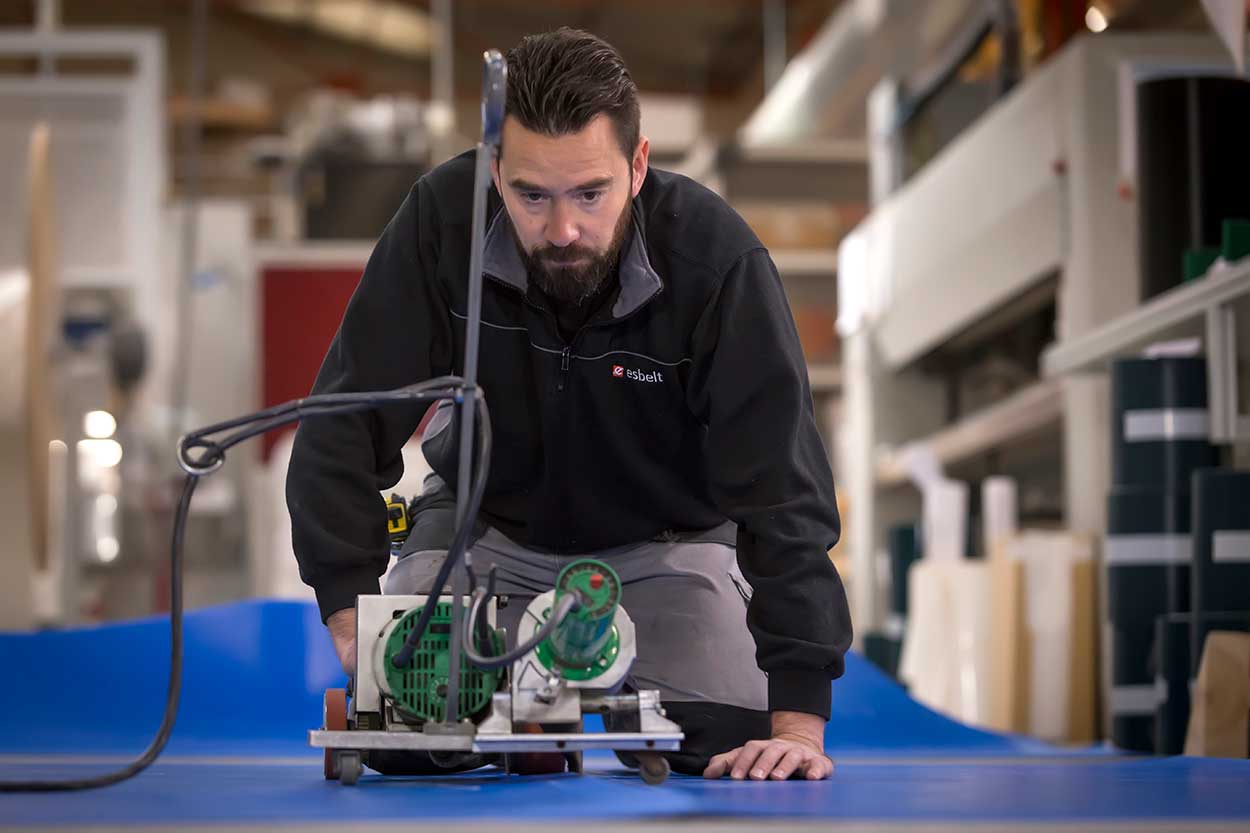
Our belt and accessory processing workshop is equipped with advanced machinery and staffed by highly qualified technicians, enabling us to customize belts to measurements and application requirements—profiles, guides, sidewalls, and more—while ensuring superior quality and a flawless finish.
Attachment of profiles and guides on fabric belts
Attachment of cleats
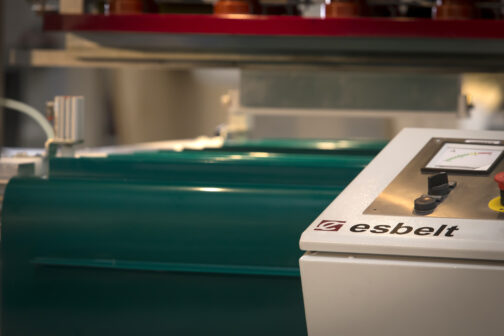
TPU or PVC cleats, flights or transverse profiles are attached using high frequency welding machine, which provides a strong, precise, and durable bond without adhesives or irregularities. This method guarantees a uniform surface and allows for the adaptation of profiles of different shapes and materials according to the application, improving performance in inclined conveyors and product sorting.
Attachment of guides
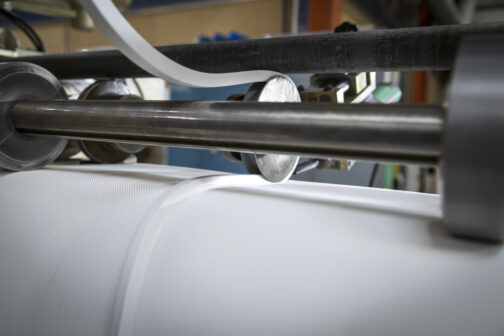
We weld longitudinal guides of varying heights to conveyor belt covers using welding machines, ensuring joint quality, mechanical resistance, and service life.
Attachment of Runer® sidewalls without base
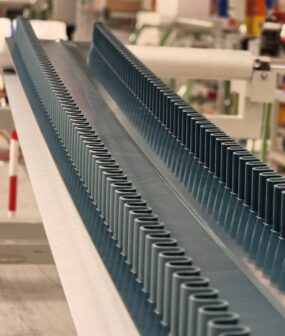
"Runer®", sidewalls without base, are welded directly onto the top cover of the conveyor belts. We have "Runer®" in PVC with and without reinforcements, and in TPU without reinforcement.
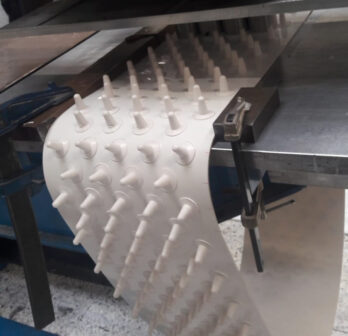
Attachment of finger and short finger profiles
“Finger” and “short finger” profiles are especially suitable for inclined conveyors of fruits and vegetables to avoid sudden impacts that could damage their appearance. In the esbelt® workshop, we weld the “finger” profile (with a minimum pitch of 100mm) and the “short finger” profiles (with a minimum pitch of 51mm between centers) onto the belts according to the needs of each application.
Custom belt fabrication
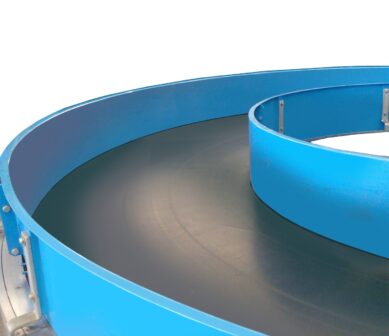
Curved belt fabrication
Curved conveyors are needed in all types of factories to save space and allow for the rapid transport of goods. At esbelt®, we have researched and developed belts and profiles for use in these curved conveyors. The possibility of obtaining a one-piece curved belt and making a single splice improves its dimensional stability, ensuring good transfer without varying the orientation of the product.
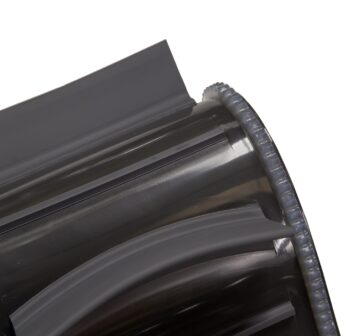
Fabrication of belts for harvesting machines
Widely used and recognized belts, robust with great transverse rigidity. High frequency machine welded profiles with high impact and tear resistance, lasting twice as long as average belts and can be repaired for up to two seasons.
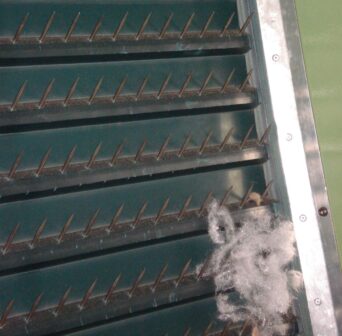
Fabrication of monoblock apron belts
Monoblock apron belts are used in bale openers to comb and stretch fibres. These are slats that hold spikes mounted on a support belt such as BREDA 25CF. NE.C14 profiles are welded on the belt and, spikes or pins are nailed in a U-shape from the bottom cover. To align the monoblock apron belts, guide profiles can be welded to the bottom cover of the belt.
Conveyor belt and transmission belt splices

Vulcanized splice of belt ends
We offer different splicing methods depending on the application: endless hot vulcanization, fingers, stepped, straight, or diagonal. For continuous and reliable joints. All splices are executed precisely in our specialized workshop, guaranteeing quality and a long service life of the belt.
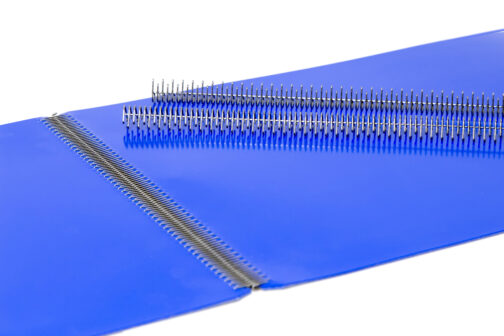
Fastener joint for belts with fabric
Joining belt ends with plastic or metal fasteners allows for quick assembly and disassembly. Hidden or semi-hidden fasteners ensure a smooth, continuous belt joint surface for sensitive applications.
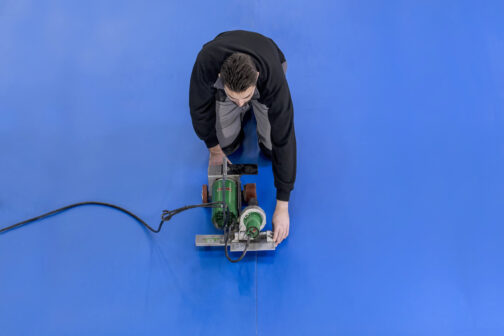
Longitudinal splice of belts with fabrics
We can perform longitudinal splices to increase the width of belts, guaranteeing a precise, stable, and continuous joint that preserves material integrity and optimizes performance in demanding applications.
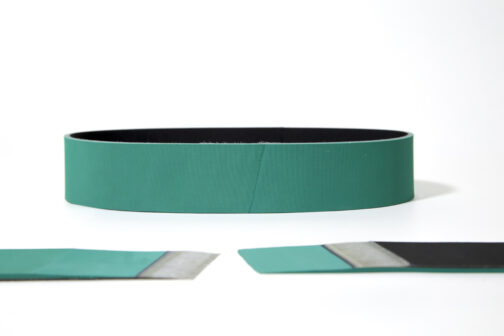
Transmission belt splices
In the esbelt® workshop, we splice leather and elastomer transmission belts with polyamide precisely and sturdily to ensure their continuous operation in mechanical systems. This process requires proper surface preparation and the use of specific tools depending on the material. The goal is to achieve a durable joint that maintains the flexibility, strength, and alignment needed to transmit power without interruptions or premature wear.
Other workshop services
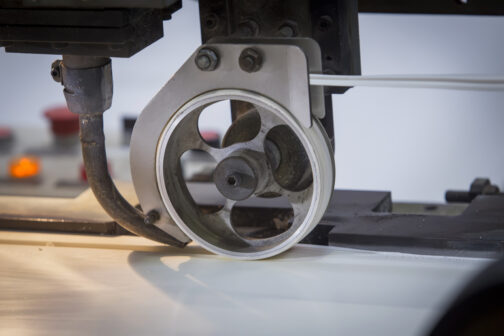
Conveyor belt edge sealing
Belt edges are sealed as an additional safety and protection measure, especially in food applications. Sealed edges prevent oils and moisture from penetrating from the sides into the conveyor belt fabric, thus preventing microbial growth and layer separation. They also prevent fabric fibers from protruding from the edges of the belt, contaminating the transported product. We can seal the edges of PVC, TPU, and TPO belts from 0.8 mm to 9.6 mm thick, with 1 to 4 layers and with smooth, matte, or embossed covers.
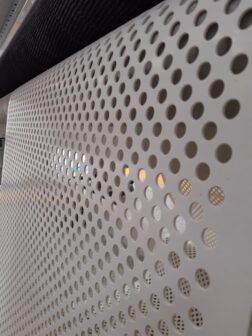
Conveyor belt perforation
Perforated belts are used in applications such as vacuum belts, drainage and filtration belts, belts for bucket elevators, and in other industrial processes. We have the ability to perforate conveyor belts in different configurations, with hole sizes between 2 and 30mm.
More information about Conveyor belt perforation ()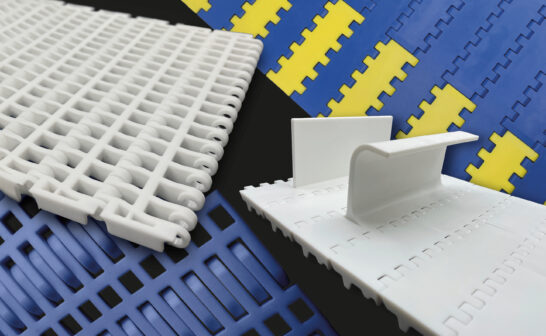
Modular belt assembly
In our workshop, we assemble Swapbelts modular belts according to the required measurements, selecting the most suitable module combination for each application. We incorporate accessories such as profiles or cleats and containment edges, guaranteeing a precise fit, optimal functionality, and compliance with technical and hygienic standards. Each belt is configured to offer reliable performance in conveying, sorting, or accumulation processes.